
James was born and raised in Battersea, London. He was seventh of eleven children, and at the time of the 1911 Census, there were 12 people living in a 3 roomed house [1]. Conditions were crowded to say the least. It is little wonder that as a young man, James had a dream of a life less crowded.
In 1914, at the age of seventeen, James boarded a ship bound for Australia in search of that life. The story told by his wife and children followed the line that James had travelled to Australia to join an older brother, Fred and his wife Lily, who had emigrated to South Australia two years earlier. When I asked him directly why he had emigrated to Australia, James answer was different to the assumption provided by his nearest and dearest. James would say “I came to join the Australian Army, (to sign up for WW1).” The next question was naturally, about why he had not joined the English army. His response “both the pay and the were better in the Australian army.”
After my teenaged interview of James, armed with this new information, I followed my own assumptions regarding his reasons for emigration, which revolved around his intention to enlist for the war, but James had withheld a key piece of information.
Thinking logically about how a 17-year-old could travel alone in the year the war began raised new questions. I found him emigrating on the Irishman, March 1914 [2]. The Passenger list consisted almost entirely of teenaged boys! There were a few girls also listed of similar ages. The girls were all listed as ‘domestic servants’, while the boys were all listed as ‘Farm Apprentices’. Interestingly, his ship sailed from Liverpool, rather than London. With WW1 just months away, this was likely a safety issue.
How had James, a city lad, gone from being a ‘printer’s messenger’ in the 1911 census to being a ‘farm apprentice’ in the passenger list?
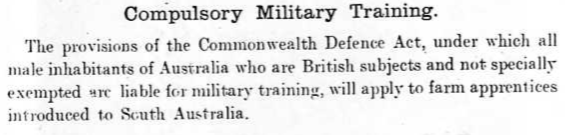
Brother Fred had undergone some agricultural training prior to emigration, likely a condition of his passage. Looking at this new information with fresh eyes, it dawned on me that James had possibly been a ‘Barwell Boy’. What transpired through further research, was that James was part of an earlier assisted immigration scheme, known as the ‘Farm Apprentice Scheme’. This scheme was aimed at providing an agricultural workforce for regional areas of South Australia. There was a contract to be signed and criteria to be met. Within the contract was a clause which stated compulsory military training would be required [3]
In James mind, this was likely his way in to the Australian Army. It explained his answers regarding his reason for emigration. His early life in South Australia was not happy. He and the farmer he was allocated to did not see eye to eye [4].

As part of his contract with the immigration department, James was required to write a monthly report to the Immigration Office. Part of his wages were given to him, the remainder were ‘held’ for him at the Immigration Office and would be paid to him on completion of his contract.[5]

James, unhappy with his placement, sought and found a new employer. This placement was however short lived. Unhappy with conditions provided by his contract with the Immigration Office, James resigned his post and enlisted for service in WW1 [6].
Discovery of James previously unknown life as a Farm Apprentice provided a significant surprise in more ways than one. It had changed the script of his arrival, but it had also provided a rich and informative file held at State Records which told the tale of his brief life as a Farm Apprentice.
References
1. Ancestry, 1911 England Census, Class: RG14; Piece: 2168, Corunna Place, Battersea, https://www.ancestry.com.au/ Accessed 25 January 2019.
2 Findmypast. “Passenger Lists Leaving UK 1890-1960”: Ship: Irishman, departing: Liverpool 21Mar1914
3. South Australia – the wheat & garden state. Opportunities for boys to become Farmers. Brochure. The commissioner of Crown Lands Immigration, p. 9.
4. State Records of South Australia: Attorney Generals Department; GRG7/3 Applications for assisted passage by agricultural laborers. 1911 – 1914. Quinlan, James no 145, 1914. Letters form James to the Immigration Department, 1914.
5. SRSA: GRG7/3, 145. Account for J. Quinlan, 1914.
6. The AIF Project, James Quinlan 2412, https://aif.adfa.edu.au/showPerson, accessed 24 January 2019.
 FamilyFoundations