Elizabeth Raven

elizabeth (raven) westMy family tree is liberally peppered with strong women. There are several I would like to meet, not least Elizabeth Raven, my great – great grandmother.
Elizabeth’s arrival in South Australia is not clear. Her father William, came to South Australia as a soldier with the 96th Regiment. One source suggests William Raven was in South Australia by 1836 [1]. While I have not found a birth record for Elizabeth, other documents suggest her birth about 1834, making her approximately two years old at the time of arrival in South Australia. Elizabeth was the second child, and oldest daughter in a family of six children. She outlived all of her siblings.

In the first South Australian Marriage in my family tree, Elizabeth married Robert West in 1853 at the Holy Trinity Church in Adelaide. Robert was 20 years old, Elizabeth 19. The first child, Frances Elizabeth, was born the following year. There were a total of twelve children born to this couple over 19 years. Five of those children would pre decease their mother.[2]

She was 38 years old when husband Robert died at the age of 40, leaving her with nine children aged between 20 and one.

I would like to talk to Elizabeth about her strength, and how she kept her family together in a time when there were no widows pensions, or any significant social support.
Providing for a large family of growing children would have required a great deal of resilience, Elizabeth appears to a have been able to hold the family together and rear strong and resourceful daughters. For me this is evidenced by the handicrafts, and resourcefulness I witnessed in my grandmother who would tell of having learned her skills from her mother, my great grandmother, Mary Ann.

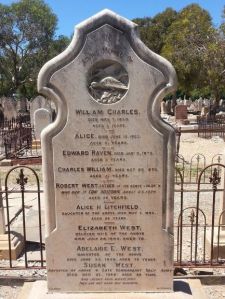
If I trace the newspaper death notices of the daughters of Elizabeth, there is evidence of headstone for robert & elizabeth west (nee raven) + several of their children. (reduced)strong bonds between them. A trait most likely forged through the need to work together for survival. In another show of unity, all of the children born to this line of women, bare the middle name of ‘West’, a way of carrying forth the family name. Only one son had survived to a marriageable age, but he did not had children. My grandmother had always been proud of her middle name and the connection it gave to her mother, and it has made the cousins of my grandmother easier to find in records.
There are so many questions I would like to ask Elizabeth Raven, matriarch of my line.


[1] Family History SA. ‘South Australian Pioneer Families’ http://familyhistorysa.org/colonists.html Accessed Jan 22, 2019.
[2] Genealogy SA. ‘On line Database’ https://www.genealogysa.org.au/ Accessed Jan 22 2019.

Snashall – an unusual name

Surnames commonly originated from the employment undertaken by an individual, in other cases it may have been based on location, or even a nickname [1]. In the case of a more unusual Surname such a Snashall, the origin is a little less clear, with no clear consensus among internet sources.

One source suggests the name as originating form the Gloucestershire area, and being derived from such variants as Kneeshall, or Snowshill [2]. Another suggests the name being a derivative of Seneschal, and meaning Steward, giving a possible occupation base [3]. In other suggestions of variants of the name, Marshall, Newhall, and Parshall are given as derivatives. In the 1891 census records found on Ancestry, there are 51 Snashall families living in Kent, and employed in occupations relating to agricultural labour [4]. This last scenario fits best with my own family history.

Thomas Snashall and Elizabeth Welch were married in Sevenoaks, Kent in 1847, and emigrated to South Australia, aboard the Indian in 1849 [5] [6]. There is no occupation listed for Thomas in ships logs. At the time of their arrival, they were the only Snashall family in South Australia.

After a harrowing journey, the family settled first in the Hindmarsh district. They had boarded the ship with one child (Elizabeth), birthed a second (Sarah), and witnessed the death of the first child within the duration of the voyage. Sarah died in May 1850, aged 13 months. Her death is recorded in the Hindmarsh district, as is the birth of Thomas William in July of that year. The birth locations of Thomas and Elizabeth’s children tell the story of their movement around the state [7].

Elizabeth – b. 1848 Kent, England – died 1849 at Sea
Sarah – b. 1849 at Sea – died May 7 1850, Hindmarsh, South Australia
Thomas William – b. July 17 1850, Hindmarsh South Australia
Richard – b. Jan 21 1852, Hindmarsh, South Australia
Charles – b. March 6 1855, Hindmarsh, South Australia
James – b. Oct 20 1857, Virginia, Gawler River, South Australia
Frederick – b. June 16, 1860, Hill River, Clare District, South Australia
Henry – b. Sept 18 1862, Hill River, Clare District, South Australia.

Of the eight children born to Thomas and Elizabeth, only Thomas William and James produced children. The name in is carried forth in South Australia via the male children born to Thomas William.

Having an unusual name, has not increased the ease of the search as you might think. In an issue common to many genealogical searches, the Snashall population of Kent appears to have shared frequently repeated Christian names, thereby ensuring confusion in tracing them with certainty.

References
[1] Wikipedia – ‘Surnames’ – https://en.wikipedia.org/wiki/Surname. Accessed Jan 16, 2019

[2] Surname DB – ‘Snashall’ http://www.surnamedb.com/Surname/ Accessed Jan 16, 2019

[3 ]Forebears website – https://forebears.co.uk/surnames/snashall Accessed Jan 16, 2019

[4] Ancestry.com – https://www.ancestry.com.au/name-origin?surname=snashall Accessed Jan 16, 2019

[5] Free BDM – ‘Thomas Snashall – Marriage’ https://www.freebmd.org.uk/cgi/search.pl Marriage of Thomas Snashall and Elizabeth Welch: Sevenoaks district 5, p.545. Accessed Jan 16, 2019

[6] The ships list – ‘The Indian 1849’. http://www.theshipslist.com/ships/australia/indian1849.shtml Accessed Jan 16, 2019

[7] Genealogy SA, ‘online database’ https://www.genealogysa.org.au/ Accessed Jan 16, 2019

The First to Arrive

#52ancestors #week1 #first

My ancestors came to South Australia from various parts of England, Scotland, with some originally from Ireland. The first of those to arrive were Charles and Susan West who arrived aboard the Prince Regent in 1839 with children Maria and Robert in tow [1].
Some sources suggest four children travelling with the family, though I have only found accurate reference and record for Robert and Maria. It is entirely possible any other children may not have survived the journey, or life in the new colony, and died before accurate records were kept.
They departed London on June 6, and arrived in Port Adelaide on September 25 1839. The state of South Australia was not yet three years old when they disembarked. The first Proclamation Day occurred on Dec 28 1836[2].  I often wonder what their first impressions of their new home was. Many people will have been living in tents, and other temporary dwellings. The streets unpaved; muddy and slippery in the wetter months, dry and dusty in the summer months.
Charles is listed as being a gardener. He has not left a large footprint to follow. Did he work establishing gardens for the city, or in stately homes? Despite his tender age at the time of arrival, son Robert (about 7 years old) is listed as a farmer. Perhaps Charles found occupation farming, and growing food for the new Colony.
The paper trail they leave is scant. Charles and Susan were apparently married in Ireland, and until I stumbled across the obituary of Maria Hall (nee West) I had no idea of where to begin looking[3]. Maria’s obituary tells us she was born in County Wicklow, Ireland. Susan’s maiden name is currently ‘Unknown’.  In keeping with their small footprint, Charles and Susan are buried in West Terrace Cemetery in an unmarked grave[4].


[1] State Library of South Australia. ‘Bound for South Australia’

[2] Adelaidia. ‘The Proclamation’ http://adelaidia.sa.gov.au/subjects/the-proclamation. accessed Jan 4 201

[3] Obituaries – Maria Hall. Critic, Adelaide SA: 1897 – 1924. Wednesday 21 Nov 1917. Page 6

[4] Adelaide Cemeteries Authority, ‘Charles West’, http”//www.aca.sa.gov/records. Accessed Jan 4, 2019.